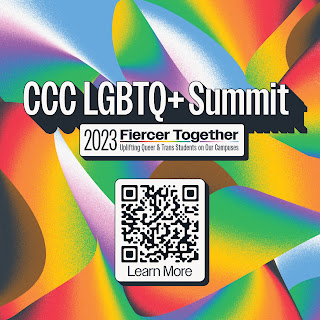
Saturday, January 14, 2023

New Web Site Home for CCC LGBTQ+ Summit


New Summit Web site: https://foundationccc.org/What-We-Do/Equity/CCC-LGBTQ-Summit 

The CCC LGBTQ+ Summit has establish a permanent home for the CCC LGBTQ+ Summit at FoundationCCC. All Summit updates are now found on their new Summit web site link here.  

The blogspot web site you are reading right now will remain up to archive the history of the Summit. Congratulations to the  CCC LGBTQ+ Summit on their new partnership with FoundationCCC!

Friday, June 10, 2022

CCC LGBTQ+ Summit Organizes for the Future

After celebrating 855 people attending the 4th CCC LGBTQ+ Summit in May 2022, organizers are looking to the future with new investments in state-wide organizing.

CCC LGBTQ+ Summit Mailing List & Leadership Email Contacts

To receive email updates on the 5th CCC LGBTQ+ Summit in 2023, please complete this contact form. For specific questions for the Planning Team, please email one of the Summit Co-Leads: Navarro Salvador (he, him, his, el) at snavarro@elcamino.edu or Dr. Emilie Mitchell (she, her, hers) at mitchee@crc.losrios.edu

Possible New Partnership

To ensure the sustainability of the CCC LGBTQ+ Summit, the Planning Team is investigating the possibility of becoming a financial impact partner with the Foundation for California Community Colleges (read more here). This move will provide several substantial benefits to our efforts and is the most likely to ensure the viability of the Summit for years to come.

Regional Networks

We have also been cultivating regional networking opportunities at the Summit. To keep things more consistent with how the CCCCO structures the state, the networks are being divided into the 10 regions identified by the CCCCO. Below are the names of each region and the colleges that encompass that region. These regional groups allow folks to work together on regional issues and report out to the larger statewide efforts.

Region 1 - Central Valley - (Bakersfield, Cerro Coso, Porterville, Merced, San Joaquin Delta,College of the Sequoias, Clovis, Reedley, Fresno City, Madera College, West Hills Coalinga, West Hills Lemoore, Taft, Columbia, Modesto Junior College)

Region 2 - Bay Area (Bay) - (Berkeley City, Chabot, College of Alameda, College of Marin, Contra Costa, Diablo Valley, Laney, Las Positas, Los Medanos, Merritt, Napa Valley, Ohlone, Santa Rosa Junior, Solano)  

Region 3 - North Far North Region - (Butte, College of the Redwoods, College of the Siskiyous, Feather River, Lassen, Mendocino, Shasta, American River, Cosumnes, Folsom Lake, Lake Tahoe, Sacramento City, Sierra, Woodland, Yuba)  

Region 4 - Bay Area 2 (Bay2) - (Cabrillo, Cañada, College of San Mateo, DeAnza, Evergreen Valley, Foothill, Gavilan, Hartnell, Mission, Monterey Peninsula, San Jose City, Skyline, West Valley City College)  

Region 5 - Inland Empire / Desert - (Barstow, Chaffey, Copper Mountain, College of the Desert, Mt. San Jacinto, Palo Verde, Moreno Valley, Norco, Riverside City, Crafton Hills, San Bernardino Valley, Victor Valley)  

Region 6 - Orange County - (Coastline, Cypress, Fullerton, Golden West, Irvine Valley, North Orange Continuing Education, Orange Coast, Saddleback, Santa Ana, Santiago Canyon)  

Region 7 - Los Angeles (LA) - (Cerritos, Citrus, Compton, El Camino, Glendale, Long Beach City, Mt. San Antonio, Pasadena City, Rio Hondo, Santa Monica)  

Region 8 - San Diego / Imperial - (Cuyamaca, Grossmont, Imperial, MiraCosta, Palomar, San Diego Continuing Education, San Diego City, San Diego Mesa, San Diego Miramar, Southwestern)  

Region 9 - Los Angeles 2 (LA2) - (East Los Angeles, LA City, LA Harbor, LA Mission, LA Pierce, LA Southwest, LA Trade-Tech, LA Valley, West Los Angeles)  

Region 10 - South Central Coast - (Allan Hancock, Antelope Valley, College of the Canyons, Cuesta, Moorpark, Oxnard, Santa Barbara City, Ventura)


CCCCO Foundation Logo


Wednesday, April 6, 2022

Programs & Schedule Announced for 4th CCC LGBTQ+ Summit

The 4th CCC LGBTQ+ Summit will be held online May 4 & 5, 2022 from 9:00am to 2:00pm both days. Check out the schedule here. The Summit includes 18 programs over 4 breakout sessions, in addition to keynotes by Bamby Salcedo and Dr. Daisy Gonzales. Register by April 20 to receive Summit swag through the mail.

Program titles include:
  • Chosen Family: Understanding the Chosen Kin Community as a Model for Liberation
  • Establishing a Task Force to Develop Comprehensive LGBTQIA+ Student Programming
  • Gender [Still] Matters: Forging Community Alliances for All-Gender Restrooms
  • Get in Formation: Showing up and Showing Out for Racial Justice and Queer Liberation
  • Hey, Hey! Ho, Ho! Palomar's Pronoun Project On The Go!
  • LGBTQ+ Campus Climate Outcomes: How Bias Disproportionately Impacts Queer and Trans Students
  • LGBTQIA2S+ Foundations Training in Canvas: Share-Out, Tips, & Discussion!
  • Queering HSIs: Leveraging Policy Unapologetically to Advance Racial Equity for LGBTQ+ community college students
  • Queering MiraCosta College: Developing an LGBTQIA+ Linked Learning Academic Success & Equity Program
  • Supporting Trans Students' Basic Needs
  • Supporting Transgender and Non-Binary Students in Pre-Service Teaching Programs
  • Trans-Affirming Campus Facilities
  • TRANSform Your Campus's Culture with a Trans Ally Program
  • Transitioning Across Statelines in Higher Education and YOUR Career
  • Transitioning Campuses: Meeting the Needs of Trans and Nonbinary Students
  • UNAPOLOGETIC: First In the Nation to Fight and Pass the LGBTQIA Student Bill of Rights
  • Understanding the Queer Community through Queer Relationships
  • Voices from Trans and Nonbinary Students
Summit Schedule At A Glance table image

Archive of 2022 Summit Programs

Chosen Family: Understanding the Chosen Kin Community as a Model for Liberation
Our queer and trans students hold the keys to their own liberation. One of these keys is "chosen family," chosen kin communities created as alternatives to birth families. This concept of chosen family is an asset our queer and trans students bring with them onto our campuses and into our classrooms. How do we incorporate this asset into the academic and social aspects of their time in college? And for what purposes? We will discuss the triumphs and challenges in answering these questions within various disciplines in the humanities and social sciences.

Establishing a Task Force to Develop Comprehensive LGBTQIA+ Student Programming
The 2017 CCC LGBTQ+ Summit inspired COD leadership, faculty, and staff to establish a taskforce to institutionalize comprehensive LGBTQIA+ student support.  Using a set of ambitious goals to guide our work, COD’s taskforce developed several recommendations that have been adopted by our District, including opening a new Gender and Sexual Diversity Pride Center and making Safe Zone training a mainstream college program.  We look forward to sharing how our taskforce got started, the paths it has taken, and how it has been an effective way to implement LGBTQIA+ programming.

Gender [Still] Matters: Forging Community Alliances for All-Gender Restrooms
Using the bathroom is a basic human need and right. Yet, at many community colleges, public bathrooms continue to be physically and psychologically unsafe for trans and gender expansive students, faculty and staff. In this presentation, we outline our advocacy efforts for all-gender restrooms at Santa Monica College. Specifically, we identify key administrative and institutional partnerships, student-driven initiatives, educational programming, and public pressure strategies that have enabled our successes. In sharing our experiences and resources, we aim to demystify the institutional process for updating extant bathroom facilities and ensuring all-gender restrooms in future building construction

Get in Formation: Showing up and Showing Out for Racial Justice and Queer Liberation
Queer liberation and racial justice movements hold shared values and a commitment to transformational change in our political and cultural institutions. However, racism, settler-colonialism, and cis-heteropatriarchy work to separate LGBTQ+ spaces from Black, Indigenous, and People of Color communities, constraining opportunities for collaboration and growth. In this workshop, presenters draw on their combined experiences working for intersectional justice as educators, advocates, researchers, and consultants. Participants will learn from examples of this work in the classroom and community-based advocacy, as well as effective strategies for bridging between on-campus and off-campus social justice work.

Hey, Hey! Ho, Ho! Palomar's Pronoun Project On The Go!
Pronouns are an important part of gender identity and a way to show respect for people and their gender, especially for those who identify as non-binary or transgender. Learn more about how one college has embraced change by increasing the implementation of chosen personal pronoun usage across campus. Strategies, suggestions, and resources will be shared in order to increase visibility, awareness, acceptance, and inclusion for students, staff, faculty, and administrators.

LGBTQ+ Campus Climate Outcomes: How Bias Disproportionately Impacts Queer and Trans Students
This presentation will be an interactive discussion about results from Delta college’s campus climate survey the Diverse Learning Environment Survey (DLE). Data will show that LGBTQ+ students report experiencing more bias and discrimination than other groups. There will be a section on intersectionality. Participants will be asked to take the Implicit Association Test (IAT) and discuss their results if they feel comfortable doing so. We will discuss our history of successes and failures concerning LGBTQ+ student services. Together in this session, we will brainstorm methods to reduce bias for our queer, trans, and non-binary students.

LGBTQIA2S+ Foundations Training in Canvas: Share-Out, Tips, & Discussion!
This long-form training is a basic training with discussions, allowing for more time and in-depth communication than a shorter 1-3 hour training. People can take their time, look things up, and it’s more accessible. We focused on terms, concepts, and the struggles of queer people. 1st half: we’ll present the 7-module LGBTQIA2S+ Foundations training we are sharing in Canvas Commons and discuss how to implement on other campuses! Second half: Let’s imagine better training! Join us in discussion of what you’ve seen on your campuses, what worked/did not, what you’d like to see, suggestions for us, etc!

Queering HSIs: Leveraging Policy Unapologetically to Advance Racial Equity for LGBTQ+ community college students
Literature around Hispanic Serving Institutions (HSI) has been on a steady increase with a focus on racialized experiences, servingness, and outcomes. Yet, much of the research is situated within the four-year higher education context. Scholarship around HSI community colleges has emerged, yet a paucity remains in explicitly centering LGBTQ+ Latinx/a/o students. This presentation will provide insight on how HSI designation can be paired with Title V and Title III policy at the implementation level through a critical policy analysis, multidimensional conceptual understanding of servingness, and queer theory lens to support Latinx/a/o LGBTQ+ community college students. Recommendations for policy and practice on how current servingness can be inclusive of LGBTQ+ Latinx students will be provided.

Queering MiraCosta College: Developing an LGBTQIA+ Linked Learning Academic Success & Equity Program
In this session, you will learn about the collaboration between MiraCosta College’s Student Equity and Counseling Departments as we work toward better supporting our LGBTQIA+ student population. First, we will (re)introduce MiraCosta College’s data collection and findings. Then, we will highlight how MiraCosta College has been supporting the LGBTQIA+ community. Specifically, we will discuss both the strides and challenges we have encountered while developing an LGBTQIA+ Linked Learning Academic Success & Equity Program virtually and in person. Lastly, we hope this session inspires you to advocate for similar equity programs at your campus to continue supporting LGBTQIA+ students.

Supporting Trans Students' Basic Needs
Our session will cover the services and initiatives of the Lionel Cantú Queer Resource Center supporting the basic needs and wellbeing of trans and non-binary students at UC Santa Cruz. With a $10,000 budget for trans-related initiatives, we distributed care packages, emergency and professional development grants, and free binders. Our basic needs services also include a gender-affirming clothing closet, anonymous food pantry, sexual and menstrual health resources, and LGBTQ-focused book/media library. We aim to demonstrate how we coordinate these initiatives so that other campus representatives might feel supported in starting or sustaining similar initiatives in their communities.

Supporting Transgender and Non-Binary Students in Pre-Service Teaching Programs
It is critical to examine the experiences of LGBTQ+ educators as a group because their lack of representation is a symptom of a larger issue in the public education system. We know that representation for marginalized groups has a critical impact on students’ lives, including issues around bullying and self esteem. Having out teachers and allies has a positive impact on the educational outcomes of all students (Kosciw et. al, 2019, p. 75). Increasing support for LGBTQ+ educators increases the likelihood that they will enter into and stay in the teaching profession, improving outcomes for students and helping to address the teacher shortage overall. Support begins in pre-service teaching programs, including affirming student teaching placements, culturally responsive pedagogy, and knowledgeable faculty.

Trans-Affirming Campus Facilities
All students, including trans students, deserve to feel recognized, safe, and a sense of belonging on campus. But campus facilities alone can make or break these feelings. So, what kinds of facility designs and policies do trans folks need you to advocate for, why are these so crucial to our well-being, and how do you make them both a priority and a reality despite limited financial resources? Brought to you by Arien Reed who began his gender transition while working on campus at Fresno City College, this session will use trans culture, factual data, and lived experiences to address these concerns, and to also offer guidance on how to inclusively meet the requirements of the new AB 367 bill.

TRANSform Your Campus's Culture with a Trans Ally Program
Some colleges have a LGBTQ+ Safe Space/Zone Ally Program but almost no colleges have a Trans Ally Program. As a trans person myself, I often feel awkward even with well-meaning colleagues who are certified Safe Space Allies, usually because they get awkward around me. During my first year of transitioning and living openly as trans, I realized cisgender folks needed more education specifically in trans culture and trans ally etiquette than the broadly inclusive Safe Space Program can provide. In this presentation, I will share the training program I developed and foster a discussion on how to start and maintain such a program at your own colleges.

Transitioning Across Statelines in Higher Education and YOUR Career
This session is for Black, Indigenous, and People of Color (BIPOC) students, faculty and staff who are deciding if they should stay or move out of state for school or work. We will have a panel of experts of Queer and Trans BIPOC students, staff who have had to move to college, graduate school or their career. We will discuss personal experiences and tips on how to navigate transitioning across state lines.

Transitioning Campuses: Meeting the Needs of Trans and Nonbinary Students
Our institutions were not built to support transgender and nonbinary students. It is up to us to make the changes needed to keep our trans, nonbinary, and queer students safe, supported, and successful. In this presentation Brit Cervantes, of the UCI Gender Diversity Program, and Erin Pollard, of the Pride Scholars Program at Irvine Valley College, will share insight into trans college experiences, relevant laws that govern this work, and ideas to create an environment where trans and nonbianary students know that they are valued members of our campus communities. Participants will leave with a greater understanding of trans student needs and a list of ideas for action items to start these changes on their campus.

UNAPOLOGETIC: First In the Nation to Fight and Pass the LGBTQIA Student Bill of Rights
The Road Passing The LGBTQIA Student Bill of Rights at The Los Angeles Community College District (LACCD) Board of Trustees approved the first-ever resolution for an LGBTQIA+ Bill of Rights on behalf of students,faculty and staff. Trustee David Vela, who chaired the Chancellor’s Advisory Committee on LGBTQIA+ Affairs, called for and unanimously passed the first in the nation resolution to serve as a national role model for other community colleges. this motion supported the creation of the Chancellor’s Advisory Committee on LGBTQIA+ Affairs to provide guidance and advice to the Board of Trustees and the Chancellor on how best to support the safety and well-being of all students and employees, specifically those in the LGBTQIA+ community, and to move the District and colleges forward in this effort; and, aware to make LACCD safe and welcoming to LGBTQIA+ students, staff, faculty and administrators.

Understanding the Queer Community through Queer Relationships
This workshop is intended to provide a deeper learning into a variety of non-heteronormative relationships and obtain more awareness and understanding of relationship definitions that are more expansive, non-monogamous, and fluid. Participants will gain a greater understanding of diverse relationships across a multitude of gender and sexual identities. We will examine the different dynamics that take place within a variety of relationships that ultimately deviate from the societal standards of the monogamous, heteronormative model. It will also touch upon media’s representation of LGBTQ relationships, as well as how social media platforms and dating apps shape relationships in the queer community.

Voices from Trans and Nonbinary Students
Join our panel of trans and nonbinary college students and recent grads as they share the specific things they wish their professors had known (or thought to ask in the first place). A chance to ask questions and hear from trans and nonbinary educators, activists, and students.


Wednesday, February 9, 2022

Deputy Chancellor Dr. Daisy Gonzales To Speak at CCC LGBTQ+ Summit

We are excited to announce that Dr. Daisy Gonzales, Deputy Chancellor of the California Community Colleges, will serve as the 2nd keynote speaker that will open up the second day of the Summit (May 5th)!

Below is a a little about Dr. Gonzales:
Born into an immigrant family in Southern California, Deputy Chancellor Daisy Gonzales spent much of her formative years in Los Angeles’ foster care system. Witnessing firsthand the numerous challenges and inequities students face, she quickly took on leadership roles in student government to advocate for student voices. After completing a bachelor’s degree in public policy from Mills College, Gonzales completed a master’s degree and PhD. in sociology from UC Santa Barbara.
Gonzales began her career in education as a dual-immersion third-grade teacher before taking on a career in fiscal policy and legislation. Gonzales served as a budget consultant for the California State Assembly Budget Committee, and was the principal consultant for the Assembly Appropriations Committee and Associate Director of Policy Analysis for California Education (PACE).
Breaking barriers for women of color, as both the first Latina to serve as Deputy Chancellor and the first to take on the role of acting chancellor, Gonzales leads the country’s largest higher education system, driving transformational change to achieve the goals of the system’s Vision for Success. Having overseen operations and strategic policy within the California Community Colleges, her experience as a leader and unapologetic anti-racist mindset, uniquely qualify Gonzales to lead the California Community Colleges.
Gonzales steers continuous efforts to highlight the work of equity and to center student success, guiding this through the Diversity, Equity and Inclusion (DEI) workgroup. The DEI workgroup has strategically organized transformational change across the system.
For more information on Dr. Daisy Gonzales, go to https://www.cccco.edu/.../Chancellors.../Deputy-Chancellor

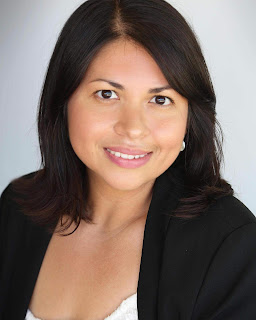
Dr. Daisy Gonzales


Tuesday, January 18, 2022

Bamby Salcedo To Speak at CCC LGBTQ+ Summit

We are excited to announce that Bamby Salcedo will serve as the keynote speaker for the first day of the Summit (May 4th)!!!

Below is a little about Bamby:
Very early in life, she experienced numerous challenges. Growing up in a poor home with a single working mother in Guadalajara, Mexico, she was drawn to the companionship and lessons of several hardships in life like childhood sexual abuse by an abusive step father, the use of drugs and surviving in the hard streets of Guadalajara Mexico as a child. Maneuvering her uneasy way through separate worlds of family, school, gangs, and LGBTQ friends, she fell into a deep cycle of drugs, crime, juvenile institutions and later, after immigrating to the US, prisons and constant street violence. Repeatedly facing her mortality, and amid many reversals, she committed herself to treatment for her addiction to work on herself and learn the root cause of what was leading the life she was living.
She then slowly began to experience, build and imagine a different and better life for herself. But Bamby’s improbable survival also inspired within her a sense of duty to help others as she recovered her life. One by one, she began to transform each challenge and each issue of her early life into the substance, basis and gravitas for her current extraordinary work, activism and life. Even now, she is always ready to credit others who assisted her transcendent rise. Bamby often speaks of herself as a “Community Investment”.
For more information on Bamby, go to http://bambysalcedo.com/


Monday, December 6, 2021

Register Now for the 4th CCC LGBTQ+ Summit


Early Bird Registration is now open for the 4th CCC LGBTQ+ Summit, an online event May 4-5, 2022. Click here for more Registration info. 

The Summit will be held online May 4-5, 2022, tentatively from 9:00 a.m. to 2:00 p.m. each day. This summit is a space for students, faculty, classified professionals, and administrators. In previous years, at least half of our attendees were students. In 2021, 947 people attended the 3rd CCC LGBTQ+ Summit online. This year’s theme is “UNAPOLOGETIC: Fighting for the Liberation of Queer, Transgender, and Non-Binary Students.” 

Early Bird Rates are $25 per student and $75 per professional. Register online by April 1 for reduced rates and by April 20 to receive a "Summit Swag" mailing. Individual registrations are also a benefit of Sponsoring the Summit.

The Summit is an opportunity to collaborate with members of the California Community College campuses at all levels.We will learn from each other’s innovative and successful ideas that will transform campuses so that we better serve and affirm LGBTQ+ students. The Summit is focused on improving not only individual community college campuses but also encouraging changes at the structural level.


Thursday, October 28, 2021

4th CCC LGBTQ+ Summit to be held online May 4-5, 2022

 The 4th Annual CCC LGBTQ+ Summit will be held online May 4‐5, 2022, with the theme of “Unapologetic: Fighting for the Liberation of Queer, Transgender, and Non-Binary Students.”” The Call for Presentations is now open with an extended deadline of January 10, 2022 to submit a proposal online. Registration is also now open..

"It would have been unimaginable only a few years ago that almost 950 people would come together to strategize on serving queer and trans students in the Community College System,” says Summit co-lead Dr. Emilie Mitchell about the 2021 Summit. “I am so excited for this year's Summit and for all the tremendous work we will do together."

The CCC LGBTQ+ Summit is an opportunity to collaborate with members of the California CommunityCollege campuses at all levels. We will learn from each other’s innovative and successful ideas that will transform campuses so that we better serve and affirm LGBTQ+ students. The summit is focused on improving not only individual community college campuses, but encouraging changes at the structural level as well.  

The Summit is co-led by Salvador Navarro and Dr. Emilie Michell, working with a state-wide Planning Team. “As a gay men of color, immigrant, first-generation and ESL student, being involved in this summit is a dream come true!” says Sal.

The Summit receives generous financial support from the Chancellor's Office of the CCC, and sponsorship opportunities will be announced soon.

Questions about the Summit may be directed to the co-leads at MitcheE@arc.losrios.edu or snavarro@elcamino.edu.

You can follow the Summit on facebook at https://www.facebook.com/cccqsummit


Call for Presentations


Monday, May 17, 2021

3rd CCC LGBTQ+ Summit draws 947 people from 120 colleges and districts

 The 3rd CCC LGBTQ+ Summit, organized by a Planning Team led by Dr. Emilie Mitchell, broke attendance records with 947 peopled registered for the online event. Participants represented 120 colleges and districts, and they learned from 16 workshops and keynotes by Chancellor Oakley and Steven Canals. 

The 4th CCC LGBTQ+ Summit will be hosted again in April 2022. In the meantime, CCC faculty, staff, and students were given a roadmap of areas to improve in the CCC system.

Students registering for the Summit were asked to rate the importance several policies and practices that might help to make campuses more welcoming and affirming to LGBTQ+ students. The ones rated the most important by the 81 students who responded are below.

  • Having mental health counseling on ca
    mpus that is LGBTQ+ affirming
     
    (95% - Very Important)
  • Training for Faculty on LGBTQ+ terminology and experiences (94% - Very Important)
  • Having a Pride Center or other staffed resource center to serve LGBTQ+ students (89% - Very Important)
  • Hate and bias reporting (having the ability to report to administration incidences of harassment and mistreatment because of sexual orientation and/or gender identity) (83% - Very Important)
  • Gender-inclusive facilities (all gender restrooms and showering/changing facilities (83% - Very Important)

That's a Wrap
 

Tuesday, March 23, 2021

Wednesday, January 13, 2021

Programs Announced for 3rd CCC LGBTQ+ Summit

Below are the Summit concurrent sessions program presentations. Click here to read the full program descriptions.

  1. Advocacy Stories:  The Long and Winding Journeys of Leading Change Initiatives
  2. Before and After COVID-19: How to Initiate and Sustain a Successful LGBTQIA+ Initiative on Campus
  3. Beyond "Checking the Box": Advancing LGBTQIA+ Data Collection at MiraCosta College
  4. Centering Student Voices: Our Journey in Creating a LGBTQIA+ Disproportionate Impact Report
  5. Challenges and Opportunities in Educating the Educators on LGBTQ+ Experience
  6. A Collaborative Approach to GSAs: Benefits of Queer Community Connections
  7. Creating a learning community to support the retention and persistence of LGBTQIA+ Students
  8. Cultural Identities: Creating success in the midst of institutional and financial barriers
  9. Fostering Resiliency in the LGBTQ ASD college student
  10. Incorporating LGBTQ+ Content in Mandatory Sexual Harassment Training
  11. Intersectional Roots: LGBTQ+ Elders Share Their Journeys
  12. Intersectional Safe Zone
  13. LGBTQ+ Visibility in the Community College Classroom
  14. Mental Health Needs Among LGBTQ+ College Students During the COVID-19 Pandemic
  15. Moving Forward: Starting an LGBTQ+ Association on Campus
  16. Queer Chisme as a counter space of Resistence
  17. Rebuilding Campus Services with and for LGBTQIA+ Students Mid-Pandemic
  18. Show Me the Data!
  19. Square One: Building Integral Support for LGBTQ+ Community College Students from the Ground Up
  20. Successful Employee Resource Groups for LGTBQ+ Employees
  21. Throwing a T-Party: How to Build Trans Spaces On-Campus
  22. Trans-Affirming Facilities
  23. TRANSforming the Classroom: Teaching Strategies that Support Transgender, Nonbinary, and Gender Nonconforming Students
  24. Uplifting LGBTQ+ Student Voices: LGBTQ+ Student Experiences with the San Diego Community College District

Archive of 2021 Summit Programs


Advocacy Stories:  The Long and Winding Journeys of Leading Change Initiatives

Kelly Munson (she/her) Student Life Advisor

Skylar Darrow (she/he) Student

Bryn Thomas (they/them)

Quinsea Pratt (she/her) Safe Place & Queer Resource Center Supervisor

Mox Andrea (she/her) IT Director

Butte College

Most change does not happen overnight, especially in higher ed.  It can be an arduous process for students who are only on our campuses for 2 +/- years.  Yet, when there is enough outrage, passion and support, change CAN happen.  Former student leaders with members of the Gender & Sexual Equity Taskforce from Butte College will share the stories of their journeys to successfully create the Chosen Name Project and the Queer Resource Center at Butte College.  Q & A will follow.


Before and After COVID-19: How to Initiate and Sustain a Successful LGBTQIA+ Initiative on Campus

Salvador Navarro (he/him) Counselor

El Camino College

In this workshop, I will be sharing the ins and outs of starting an LGBTQIA+ initiative on a college campus. Topics of discussion will include: sponsorship/budget, marketing, branding, engagement, buy-in from key stakeholders, the process of forming a committee, partnerships and much more. Specifically, I will be sharing the work we have done face to face and how we are rendering our services and hosting our events in an online format due to our current COVID-19 situation. This workshop is designed for staff, administrators and students who also wish to be a voice for the queer services they wish to see on their campus grounds.


Beyond "Checking the Box": Advancing LGBTQIA+ Data Collection at MiraCosta College

Lisa Trescott (she/her) Research Analyst, Student Equity and SSSP

Kristina Londy (she/her) Program Manager Student Success & Equity, LGBTQIA+ Campus Liaison

MiraCosta College

In this session the staff of MiraCosta College will share our best practices for collecting useful data on the LGBTQIA+ Community. Given the historical obstacles with collecting reliable data on this community and the limited data that CCC’s get from the chancellor's office, colleges are often left on their own finding creative solutions to this problem. During this session we will share with you the inspiration for our data collection practices, how we’ve been able to collect data to help us better understand the LGBTQIA+ student population and their needs, as well as how we plan to use this data to inform our future initiatives.


Centering Student Voices: Our Journey in Creating a LGBTQIA+ Disproportionate Impact Report

Dr. Roger Davidson (he/they) Dean, Natomas Education Center

Alejandra Fernandez Garcia (they/them) Pride Center Specialist

Bee Curiel (they/them) SPA, Student Ambassador Program

American River College

This presentation will cover the framework that led our campus to request a disproportionate impact report for our LGBTQIA+ students, the data we used to drive the report, and the process we used to hear student voices.  We will touch on the challenges our team faced and how we learned to overcome them. Our presentation will conclude with the recommendations that report provided back to our campus community which focused on QTBIPOC students as a intersectional way to improve the student experiences of all students in the LGBTQIA+ spectrum.


Challenges and Opportunities in Educating the Educators on LGBTQ+ Experience

Dr. Steph Anderson (they/them) Assistant Professor of Psychology

Students from the Gender Sexuality Alliance

Santa Monica College

As a collective of LGBTQ+ student leaders, we engage in a variety of institutional spaces (e.g., student government, student clubs, advisory boards) at Santa Monica College (SMC). Our goal is to make SMC a safer and more inclusive campus for queer and trans students, in particular for those of us who experience the most marginalization. In this workshop, we discuss our leadership and advocacy efforts at SMC. Specifically, we reflect on our experience designing and implementing “LGBTQ+ 101” Workshops on campus and the challenges and opportunities inherent in partnering with faculty, staff, and administrators in these efforts.


A Collaborative Approach to GSAs: Benefits of Queer Community Connections

Kelly Ramnarine (she/her) President, Community Officer Gender Sexuality Alliance and QueerSCV

Katie Lookholder (she/her) Adjunct Professor

College of the Canyons

This session will encompass the beneficial relationship between the College of the Canyons Gender Sexuality Alliance and QueerSCV, a Santa Clarita Valley LGBTQ+ community organization.This collaborative approach to LGBTQ+ student support services has resulted in beneficial outcomes that may not have otherwise been possible, including but not limited to:

• On-Campus Event Support: COC LGBTQ+ Pride, National Coming Out Day.

• Collaborative Projects: 2020 Queerantine Zine, SCV Virtual Pride.

• Connection to the Greater LGBTQ+ Community: Safe Adult LGBTQ+ Mentorship, Santa Clarita Valley Pride, Fieldtrips(Zoo, Beach, etc.), LGBTQ+ Bookclub, Queer Friendsgiving."


Creating a learning community to support the retention and persistence of LGBTQIA+ Students

Dr. Guadalupe Corona (She/Her/Ella)Director, Office of Student Equity Programs and Services; Southwestern College 

Kimi Rodriguez-McSwain (she/her) Chel Coordinator/Counselor; Southwestern College

Dr. James Wilson English Faculty; Diablo Valley College

Dr Corona leads the office of student equity at Southwestern. In collaboration with Ms. Rodriguez Mc Swain and Dr. Wilson, they will share their efforts to support an LGBTQIA+ learning community. Both faculty members are leaders in developing a learning community to provide safe space for students. And Dr. Corona will share the role of student equity in supporting these efforts.


Cultural Identities: Creating success in the midst of institutional and financial barriers

Ernesto Nery (he/him) Director, Financial Aid

Merritt College

Being of multi-racial, first-generation, and a gay college student of undocumented parents has been a struggle in my young adult life. This has led me to internally explore my multiple identities, which often has caused discrimination, stigma and rejection. Further, the lack of parental and financial support made it difficult to afford college expenses, causing social and psychological barriers. Therefore, working in the Financial Aid Office, I have had the privileged to interact with students who face similar experiences. Cultural norms have a significant effect on the success of students, resulting in LGBTQIA+ students to often receive inadequate tools needed to succeed in college. This session will focus on available financial aid resources to support LGBTQIA+ students, primarily students who have little to no financial support from their parents or have become homeless as a result.


Fostering Resiliency in the LGBTQ ASD college student

Bryan Scheihing (he/him) Licensed Therapist and Training Director

Dr. Laurie Stephens (she/her) Senior Director of Autism and LGBTQ Programs

The Help Group's Kaleidoscope Program

How can we best support LGBTQ+ youth with autism in the college environment?  Being LGBTQ+ is often met with adversity and maybe even rejection in multiple settings.  Individuals with autism may face a broad range of challenges and stigma as well.  Research indicates that people who experience the intersectionality of being in both of these populations benefit greatly by receiving affirming support from others.  Join us to learn about the importance of providing affirming support for the population of LGBTQ+ young adults who are also diagnosed with autism, including examples of how to do so.


Incorporating LGBTQ+ Content in Mandatory Sexual Harassment Training

Dr. Cindy Vyskocil (she/her) Vice Chancellor of Human Resources; South Orange County Community College District

Flavio Medina-Martin (he/him) Director of Diversity and Inclusion;College of the Canyons

Gregory Smith (he/him) Vice Chancellor of Human Resources; San Diego Community College District

Jake Knapp (he/him) General Counsel; Los Rios Community College District

With the recent Supreme Court Decision (BOSTOCK V. CLAYTON COUNTY) and legislation mandating sexual harassment training for all employees (SB1300 and SB 1343) join us for a panel discussion on federal and California laws and regulations regarding sexual harassment and strategies to incorporate LGBTQ+ content into our harassment trainings.


Intersectional Roots: LGBTQ+ Elders Share Their Journeys

Mason Funk (he/him) Executive Director; The Outwords Archive

"Intersectional Roots: LGBTQ+ Elders Share Their Journeys" will look at the origins of intersectionality, both as a concept, and in the lived experiences of three queer California elders with intersecting identities. These individuals include a Chinese-American lesbian poet, a Latinx mental health provider, and a transgender Latinx/Indigenous community organizer. The subjects' stories will be presented in their own words via short (3-4 minute) videos and through in-person participation in the panel (subject to confirmation). Their stories will provide inspiration and orientation for students and others living with intersecting identities, and delve into the queer community's responsibilities for anti-racism work.


Intersectional Safe Zone

Magdalena Munoz (she/her) Counselor

Jason Reyes (he/him) President of Associated Students of Rio Hondo College (ASRHC)

Rio Hondo College

The Intersectional Safe Zone training explores the various experiences of Queer students of color with various *isms (racism, classism, sexism, and more) in higher education. Queer students also make comprehensive recommendations to address inequalities and provide holistic support in their journey.


LGBTQ+ Visibility in the Community College Classroom

Wendy Silva (she/her, they/them) Assistant Professor, English

Robert Hyers (he/him) Assistant Professor

Dr. Andrea Dillon (she/her, they/them) Associate Professor, Life Sciences

Dr. Bryan C. Keene (he/him) Assistant Professor

Diana MacDougall (she/her) Professor; ASL/Interpreting Program Coordinator

Riverside City College

In our panel, we will discuss how, within our given disciplines at the community college, which include ASL, Life Science, English & Composition, and Art/Art History, we’ve worked to bring LGBTQ+ visibility into our classrooms and interrogate it using the same intersectional lens we use to interrogate other identities within our classrooms. We aim to move beyond representations that tokenize, exotify, or “other” our community, into authentic, empowering representations that affirm the identities and experiences of our LGBTQ+ students. We will share concrete examples of how we have examined and critically re-imagined  LGBTQ+ visibility in our classrooms and on campus.


Mental Health Needs Among LGBTQ+ College Students During the COVID-19 Pandemic

Emilio Loret de Mola (he/him)

Lena Robertson (they/them)

Vanderbilt University

Following the closure of many colleges and universities in the spring of 2020, our team conducted a study to understand how the COVID-19 pandemic may have placed some LGBTQ+ college students in unsafe or unaccepting environments that could negatively impact their mental health and wellbeing. The data collected from our first survey shows that more than half of our sample experienced psychological distress, anxiety, and depression at the beginning of the pandemic. We recommend that universities adapt resources and services to provide LGBTQ+ students better access to mental health support as learning continues in various environments outside of the classroom.


Moving Forward: Starting an LGBTQ+ Association on Campus

Al Weyant-Forbes (he/they/she) EOPS Specialist

Wendy Silva (she/her, they/them) Assistant Professor, English

Deborah Brown (she/her, they/them) Assistant Professor, History

Riverside City College

Progress can be slow sometimes, but it happens! In absence of an LGBTQ campus center or a unified LGBTQ campus-wide organization, Riverside City College recently created an LGBTQ+ Association for Student Success and Equity (LASSE) comprised of classified professionals, faculty, students, and administrators. Come learn the steps we took to create the Association, along with the work that LASSE is currently doing - including a pilot mentor program, events, and advocacy for campus-wide positive change. Let’s also have a discussion about the work of attendees’ campuses, and how we can individually and collectively continue to work toward equity for LGBTQIA2+ students.


Queer Chisme as a counter space of Resistence

Ángel Gonzalez (he/they/elle) Graduate Research Associate; San Diego State University

Yolanda Cataño (she/her/ella) Interim Associate Dean of Institutional Effectiveness, Equity, and Student Success; Imperial Valley College

SergioGonzalez (el/him) Research Associate; Rutgers College:Center for Minority Serving Institutions

As queer Latinx individuals, we want to share space, coutnerspace to engage in what we call, queer chisme as a tool to hold, disrupt, and demand space with my participants for our survival and existence (Gutierrez, 2017).  Rooted in feminist knowledge production, queer chisme serves as a disruptive tool towards homosocial practice permitting us, QTPOC folx, to share experiences that “exposes the violent impact heteronormative ideologies have material reality” (Gutierrez, 2017, p. 130). Chisme is not seen as a true form of knowledge and is marginalized as “silly, trivial, and unreliable” within our cisgenderheteropatriarchal society; therefore, it serves as a counterspace to exist, resist, and transform current practices (Gutierrez, 2017). Although research around gossip as discourse exists, chisme looks again at the intersections of race, ethnicity, gender, and sexual orientation.  Engaging in queer chisme with our chismosxs in this context then possesses the power to transform community colleges and our work.


Rebuilding Campus Services with and for LGBTQIA+ Students Mid-Pandemic

Dr. Gregory J. Langner (he/him) Full-Time Instructor

Dr. Carina Karapetian Giorgi (they/them) Faculty & Department Chair of Sociology, Anthropology, Administrative Justice and Psychology

Dr. Jill Zimmerman (she/her)  Dean of Student Life 

Allison Burch (she/her) Instructor / Librarian

Antelope Valley College

As California Community Colleges labor to maintain services supporting Queer students, the Antelope Valley College LGBTQIA+ Committee — a joint endeavor between students and faculty — works to institutionalize Queer-affirming programs and policies that have primarily until now been promoted and practiced informally. Sharply aware that remote learning made necessary by the pandemic disproportionately impacts LGBTQIA+ students (The Trevor Project, 2020) — whom already often manage higher levels of anxiety, isolation, and even violence (Seaman, 2017) — we aim first and foremost to signal to the campus community at large our steadfast support for our Queer and questioning students.


Show Me the Data!

Dr. Valerie Lundy-Wagner (she/her) Assistant Vice Chancellor, Research and Data;

Educational Services and Support

Dr. Shuai Li (she/her) Research Data Specialist; Educational Services and Support

California Community Colleges Chancellor’s Office

Show me the data! Campuses are increasingly focused on making “data driven decisions”, however, data on the queer and trans community on our campuses can be hard to obtain and hard to understand. This presentation will present historical and background information on the sexual orientation and gender identity questions on the CCC apply (AB620)- highlighting some of the limitations and issues faced with these questions and how the data is collected. Data on the number of queer and trans student across the CCC system will be presented as well as findings on the success and retention rates of queer and trans students relative to their heterosexual and cisgender counterparts.


Square One: Building Integral Support for LGBTQ+ Community College Students from the Ground Up

Dr. Kyle Livie (he/him) Professor of History/Co-Director, Lytton Center for History and the Public Good

David Irving (he/him) Counselor/Mental Health Coordinator

Dr. Sandra Chacko (she/her) Associate Professor of Anthropology

Ohlone College

Do you look around your campus and think "where do I even start?" This presentation will explore practical strategies for creating and maintaining integrated LGBTQ+ programming on community college campuses with histories of limited or sporadic support for queer and trans students. The goal of this presentation is to help YOU envision, design, and implement programming that can be integrated with other efforts on campus including professional development, equity, mental health services, and curriculum development. You will learn about ways to assess your own knowledge about LGBTQ+ identity and issues as well as your campus climate, approaches to increase awareness in your community, and strategies to use your work to provide support to other disproportionately-impacted populations. The presenters will share tips, experiences, and identify key ways to build services/supports/spaces for LGBTQ+ students, including approaches that can translate to online modalities, ways to overcome institutional obstacles, and techniques for working with different stakeholders. Let’s get started together!


Successful Employee Resource Groups for LGTBQ+ Employees

Dr. Claudia Mercado (she/her) Interim Vice President for Diversity, Equity, and Inclusion

Harper College 

LGBTQ+ employees need to have visible counter spaces throughout the college. Counter spaces provide safe spaces that simultaneously validate and critique one’s interconnected self and group identity that would enable radical growth. (Keels, 2019). Counter spaces allow for LGBTQ+ employees to unpack other challenges/questions they have.   These counter spaces can be through providing a LGBTQ+ employee resource group (ERG). ERG’s are employee recognized groups that center on employee identities such as race, ability or sexuality. ERG’s help provide an inclusive workplace which increases employee engagement, commonalities across divisions and intersections across an employee’s identities.


Throwing a T-Party: How to Build Trans Spaces On-Campus

Charlie Garcia-Spiegel (he/him) Student Lab Aide

Juan Fernandez (he/him) Coordinator OF Queer Resource Center

City College of San Francisco

Recent widespread campus closures, as well as a previous displacement of City College of San Francisco’s Queer Resource Center (QRC), have resulted in a student-led push to re-establish the QRC. Drawing from the QRC’s 15 year history as the first LGBTQ+ resource center in the CCC system, a student worker created the T-House: a virtual space for transmasculine and masculine-of-center people. This presentation will showcase programming from the T-House’s initial semester, highlight its contributions to the establishment of a trans-affirming campus culture, and provide a framework for establishing physical and virtual trans-centered spaces throughout California.


Trans-Affirming Facilities

Arien Reed (he/him) President of LGBTQ Allied Staff & Faculty Association

Fresno City College

What kind of campus facilities benefit our trans students, employees, and visitors, why is it so important that colleges provide them, and how do we advocate for them? How do we request costly change to existing facilities on a campus possessing limited financial resources? Come learn and share what kinds of facility renovations and policies trans folks need you to advocate for, why these modifications are so crucial to our well-being, and how to make them both a priority and a reality.


TRANSforming the Classroom: Teaching Strategies that Support Transgender, Nonbinary, and Gender Nonconforming Students

Catherine Lamar (she/her) Psychology Instructor; Pasadena City College

Shelby Lamar (they/them) Assistant Director, Preparing Future Faculty Program; Claremont Graduate University

Have you checked that your classroom environment, syllabi, activities, and teaching practices are inclusive to transgender, nonbinary, agender, and gender nonconforming students? This workshop will discuss best practices in creating a safe, inclusive, and open classroom environment for students of all gender identities. Co-facilitators, Catherine Lamar and Shelby Lamar, will discuss strategies that educators can use when designing course materials, syllabi, first-day-of-class activities, and student resources that support and affirm LGBTQ+ students. Attendees will leave this session with tangible practices to implement in classrooms, including a checklist to design your course with gender-inclusive practices.


Uplifting LGBTQ+ Student Voices: LGBTQ+ Student Experiences with the San Diego Community College District

Jaime Seiverd (they/them) Research and Planning Analyst

San Diego Community College District

The San Diego Community College District conducted focus groups in Spring and Fall 2020 to better understand diverse LGBTQ+ student experiences to inform future programming and support services for LGBTQ+ students. Students discussed their intersecting identities and how those identities informed their experiences with campus climate, the curriculum and classroom, various support services, and extracurricular activities. This presentation will detail the methodology and intention of this project, themes that emerged from student participants during analysis, and next steps for continuing intersectional research on LGBTQ+ students in the San Diego Community College District.



New Web Site Home for CCC LGBTQ+ Summit

  New Summit Web site:  https://foundationccc.org/What-We-Do/Equity/CCC-LGBTQ-Summit  The CCC LGBTQ+ Summit has  establish a permanent home ...